Crowded Out: How Reflexive Market Cycles Consume Their Own Fuel and Leave Late Traders Stranded
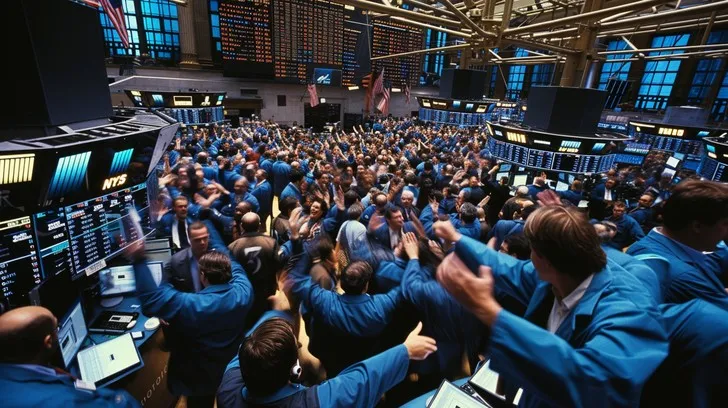
Photo: crowded stock market trading floor investors rushing exit, via images.stockcake.com
Every powerful market narrative carries within it the seeds of its own undoing. When enough capital chases a single thesis, the mechanism that created the trade begins to erode it—and the traders who entered earliest are often the only ones who escape intact. Understanding George Soros's reflexivity framework is not merely academic; it is a survival skill for the active trader operating in consensus-heavy markets.
The Architecture of a Reflexive Cycle
At its core, reflexivity describes a feedback loop between market participants' perceptions and the underlying reality those perceptions are meant to reflect. Soros articulated the concept decades ago: investors do not simply respond to objective fundamentals; their collective behavior actively shapes those fundamentals in return. A rising stock price attracts capital, which pushes the price higher still, which validates the original thesis—until it doesn't.
The cycle operates in two phases. During the self-reinforcing phase, the gap between perception and reality widens in the direction of the prevailing bias. Prices rise or fall beyond what fundamentals alone would justify, and each successive move recruits new believers. During the corrective phase, that same gap collapses—sometimes violently—as the conditions sustaining the narrative deteriorate faster than consensus can adapt.
For active traders, the critical insight is that both phases offer opportunity. The danger lies in failing to distinguish between them.
Case Study One: Meme Stock Mania and Terminal Velocity
The GameStop episode of early 2021 represents one of the most visible reflexive cycles in recent US market history. The initial thesis—that heavily shorted, undervalued retail names could be squeezed against over-leveraged institutional short sellers—was structurally sound in its early stages. The self-reinforcing loop was explicit: retail buying pressure forced short covering, which drove prices higher, which attracted more retail buying, which generated media coverage, which attracted still more participants.
The terminal signal, however, was hiding in plain sight. By the time GameStop was trading on the front page of every major financial publication and appearing in congressional testimony, the trade had long since passed its inflection point. The original short interest that provided the mechanical fuel for the squeeze had been substantially covered or hedged. What remained was pure reflexive momentum—a narrative sustaining itself on inflows from participants who arrived after the underlying thesis had already exhausted its catalytic power.
Traders who recognized this distinction—who understood that the story had become the trade rather than the trade reflecting a story—had an actionable edge. Those who mistook consensus enthusiasm for fundamental confirmation paid the consequences.
Case Study Two: The Crypto Supercycle Narrative
The 2020–2021 cryptocurrency rally offers a more complex illustration of reflexivity operating across multiple asset classes simultaneously. Bitcoin's appreciation attracted institutional validation, which attracted further institutional capital, which in turn produced the regulatory and media attention that legitimized the asset class in the eyes of a broader audience. Altcoins rode the coattails of this narrative, with each successive speculative vehicle drawing in participants who had missed the preceding move.
The reflexive mechanism here was amplified by leverage—not merely financial leverage, but the leverage of narrative itself. Concepts such as "digital gold," "inflation hedging," and "institutional adoption" provided intellectual scaffolding that allowed participants to rationalize positions that were, in structural terms, increasingly crowded.
The corrective phase, when it arrived in 2022, demonstrated a characteristic feature of reflexive unwinding: speed asymmetry. The self-reinforcing phase had taken months to build; the corrective phase compressed years of narrative construction into weeks of price destruction. This asymmetry is not coincidental. When a crowded trade reverses, participants who entered late have the weakest conviction and the least favorable cost basis—they exit first and fastest, accelerating the very move they are fleeing.
Identifying Terminal Velocity: The Practical Signals
Recognizing when a reflexive cycle is approaching exhaustion requires monitoring several converging indicators simultaneously.
Sentiment saturation is the most accessible. When the prevailing thesis dominates mainstream financial media, appears in retail investor forums, and is cited as consensus by institutional research desks, the marginal buyer who could sustain further momentum is increasingly scarce. Sentiment surveys, options positioning data, and fund flow reports can quantify this saturation more precisely than anecdotal observation.
Structural deterioration beneath the surface narrative is often more reliable. In the meme stock context, this meant tracking actual short interest data rather than assuming it remained elevated. In momentum rotations, it means monitoring the breadth of the sector move—when leadership narrows to a handful of names while the broader cohort stalls, the self-reinforcing mechanism is losing its base.
Positioning crowding as measured through commitment of traders reports, prime brokerage data, and options open interest can reveal when a thesis has been fully expressed in market structure. A trade that is universally owned cannot be further bid by the existing participant base; it can only be sustained by the arrival of new entrants, a pool that is by definition finite.
Narrative fragility is perhaps the subtlest signal. When the bull case for a crowded trade requires increasingly precise conditions to remain valid—when any deviation from the expected path is rationalized rather than acknowledged—the thesis has become brittle. Robust investment theses accommodate disconfirming evidence; reflexive narratives at terminal velocity cannot.
Executing the Exit Before Consensus Unwinds
Knowing that a reflexive cycle is approaching exhaustion and acting on that knowledge are distinct challenges. The self-reinforcing phase can persist longer than any individual trader's patience or capital reserves, and premature exits sacrifice real returns.
A structured approach involves scaling out of positions incrementally as the terminal signals described above accumulate, rather than attempting to identify a precise peak. This technique—sometimes described as "selling into strength"—accepts a suboptimal exit price in exchange for execution certainty. In highly liquid markets, this is straightforward; in less liquid vehicles, it requires planning well in advance of the anticipated reversal.
Hedging the residual position through options—specifically, purchasing puts or put spreads on crowded names as sentiment saturation becomes evident—allows traders to retain exposure to the remaining momentum while limiting downside if the corrective phase arrives abruptly. The cost of this insurance is typically elevated precisely when the narrative is at its most compelling, which is itself a signal worth heeding.
Finally, maintaining a written record of the original thesis and the conditions under which it was expected to remain valid provides a disciplined check against the narrative drift that characterizes crowded trades in their late stages. When the reasons for holding a position have shifted materially from the reasons for entering it, that discontinuity demands explicit acknowledgment.
The Reflexive Edge
Soros's framework is most valuable not as a description of market pathology but as a practical lens for identifying where in a cycle a given trade currently resides. Markets will always produce reflexive episodes; the structure of human cognition and the mechanics of capital flows guarantee it. The active trader's advantage lies not in avoiding these cycles—they are frequently where the most significant returns are generated—but in maintaining clear-eyed awareness of their internal logic and their inherent limits.
The trade that works because everyone believes in it will eventually stop working for precisely the same reason.